Tracking the 20 July 2026 European Supercell Outbreak
How iklim.co followed one of Europe's most destructive hail events in real time
On 20 July 2026, a powerful convective storm system developed over Northern Italy and evolved into one of the most significant severe weather outbreaks of the summer. Producing giant hail, destructive winds, and widespread agricultural and property damage, the storm crossed multiple countries while maintaining remarkable intensity.
For insurers, reinsurers, and risk managers, it offered a compelling demonstration of why real-time storm intelligence is becoming essential for catastrophe operations.
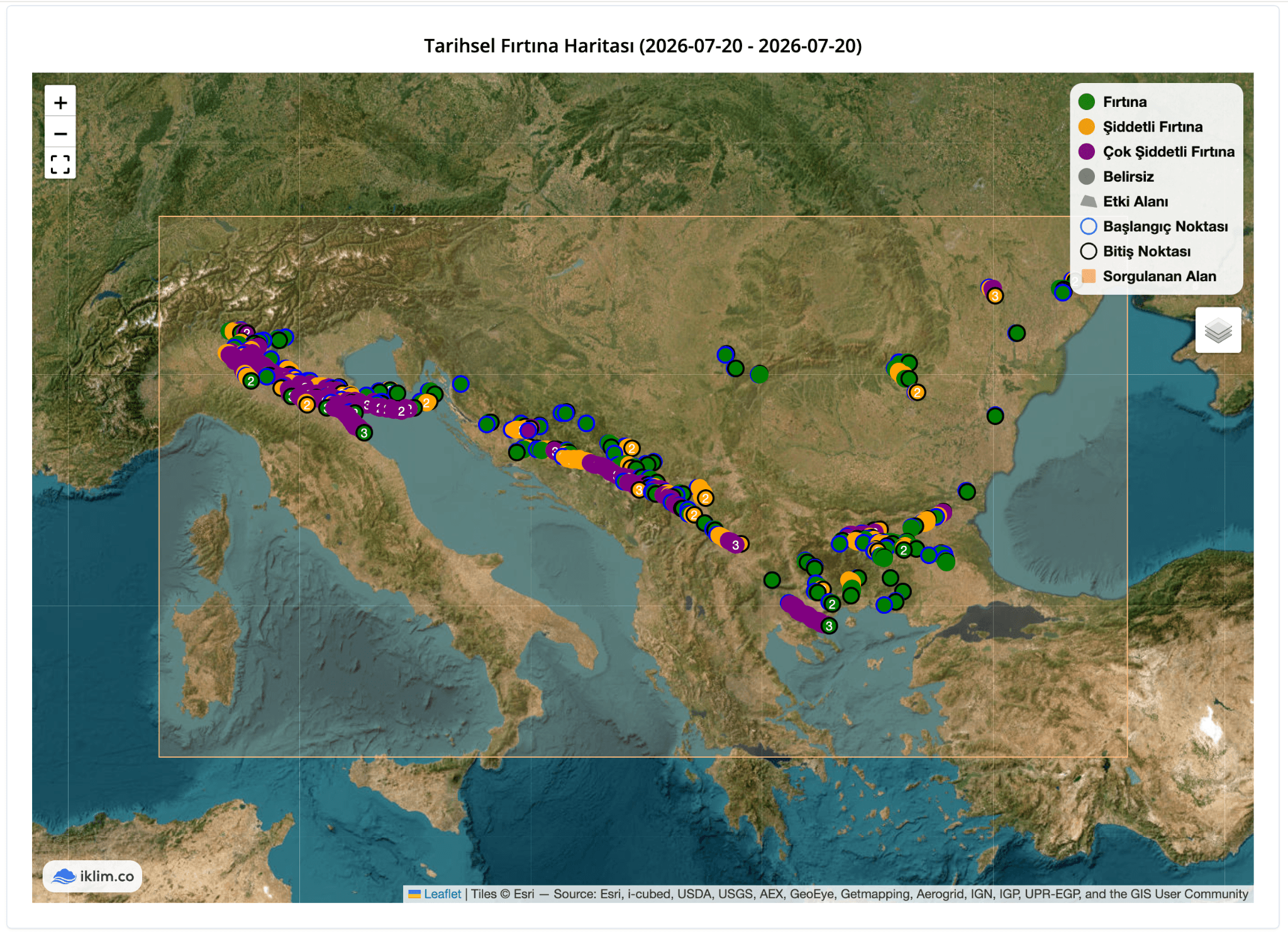
At iklim.co, our Storm Intelligence Platform continuously tracked the event from its initiation in Northern Italy to its dissipation over the Western Balkans, providing a detailed picture of the storm's evolution and potential impact.
A Storm That Crossed Borders
Unlike many thunderstorms that weaken within a few hours, this event evolved into a long-lived severe convective system.
Beginning over Italy's Po Valley, the storm rapidly intensified under favorable atmospheric conditions characterized by strong instability and vertical wind shear. Several rotating supercells formed, producing extremely large hail and damaging straight-line winds.
Instead of dissipating after crossing the Alps, the system maintained its organization while moving eastward across:
- Italy
- Slovenia
- Croatia
- Bosnia & Herzegovina
- Serbia
Throughout its journey, new storm cells repeatedly developed along the outflow boundary, extending the event over nearly 900 kilometers.
Reported Impacts
International media reported significant damage across multiple countries.
Northern Italy
The first supercells produced:
- Giant hail measuring up to 10–15 cm in some local reports
- Thousands of lightning strikes
- Damaged vehicles
- Roof failures
- Significant agricultural losses
Satellite imagery even captured the storm's distinctive V-shaped cloud structure, a classic indicator of an exceptionally organized severe thunderstorm.
Croatia and Slovenia
As the storm crossed the Adriatic corridor, it generated another round of destructive weather:
- Large hail
- Severe downburst winds
- Fallen trees
- Damaged greenhouses
- Infrastructure disruption
Emergency services responded to numerous weather-related incidents as the system moved eastward.
Bosnia & Herzegovina
The storm retained severe intensity after entering Bosnia.
Local reports included:
- Very large hail
- Crop destruction
- Vehicle damage
- Roof failures
- Localized power outages
The event demonstrated how a single organized storm system can generate insured losses across several countries within a single day.
Seeing the Entire Storm — Not Just the Damage
Traditional catastrophe assessment often begins after claims are reported.
Storm intelligence changes that approach.
During this event, the iklim.co platform continuously monitored:
- Storm initiation
- Storm movement
- Cell development
- Severity changes
- Cross-border continuity
- Estimated impact footprint
Rather than relying solely on weather warnings or post-event reports, insurers could visualize the actual path of the storm while it was unfolding.
Why Storm Tracking Matters for Insurance
Every severe convective storm creates uncertainty.
Questions immediately arise:
- Which insured assets are exposed?
- Where will claims likely emerge?
- Which regions require rapid response?
- How should catastrophe teams be deployed?
Answering these questions quickly is critical.
Real-time storm intelligence allows insurers to move from a reactive claims process to proactive catastrophe management.
Operational Benefits
Storm intelligence supports multiple business functions across the insurance value chain.
Claims Management
Claims teams can prioritize resources by identifying the areas most likely to generate losses before the first notice of loss arrives.
This reduces response times while improving customer experience.
Agriculture Insurance
For agricultural portfolios, storm footprints can be compared with insured farm locations to rapidly identify potentially affected producers.
This capability also supports parametric insurance products where predefined weather conditions trigger payouts without requiring traditional loss adjustment.
Motor Insurance
Large hail events often result in thousands of damaged vehicles.
Storm tracking enables insurers to estimate vehicle exposure, communicate with policyholders, and prepare repair networks before claim volumes peak.
Property Insurance
Roof damage caused by hail and severe winds represents one of the largest sources of property claims.
Knowing exactly where severe storm cores travelled allows insurers to estimate portfolio accumulation and allocate field resources efficiently.
Reinsurance
Historical storm replay provides valuable event reconstruction for catastrophe analysis, portfolio assessment, and treaty discussions.
From Weather Data to Operational Intelligence
Weather observations alone rarely answer business questions.
The real value lies in transforming meteorological information into operational decisions.
The iklim.co Storm Intelligence Platform combines:
- Automatic storm detection
- Storm cell tracking
- Severity classification
- Historical replay
- Cross-border event continuity
- Impact footprint estimation
Together, these capabilities provide insurers with a comprehensive understanding of severe weather events as they unfold.
A Real-World Validation
The 20 July 2026 European Supercell Outbreak serves as an excellent validation of storm intelligence technology.
The historical replay produced by iklim.co closely matches the areas where international media later reported giant hail, damaged infrastructure, agricultural losses, and widespread insurance impacts.
This demonstrates how real-time atmospheric intelligence can become a practical decision-support tool rather than simply another weather visualization.
Looking Ahead
Climate change is increasing the frequency and severity of localized extreme weather events across Europe.
Convective storms are becoming more difficult to predict, more damaging, and increasingly important for insurers managing portfolios exposed to hail, wind, and flash flooding.
Organizations that can identify storm impacts before claims begin arriving will be better positioned to improve operational efficiency, reduce catastrophe costs, and deliver faster support to policyholders.
Storm intelligence is no longer simply about tracking the weather.
It is about enabling better business decisions.
About iklim.co
iklim.co is a Storm Intelligence Platform that detects, tracks, and analyzes severe weather events in real time. Our technology helps insurers, reinsurers, utilities, transportation companies, and critical infrastructure operators transform atmospheric data into actionable operational intelligence.
Learn more: https://iklim.co