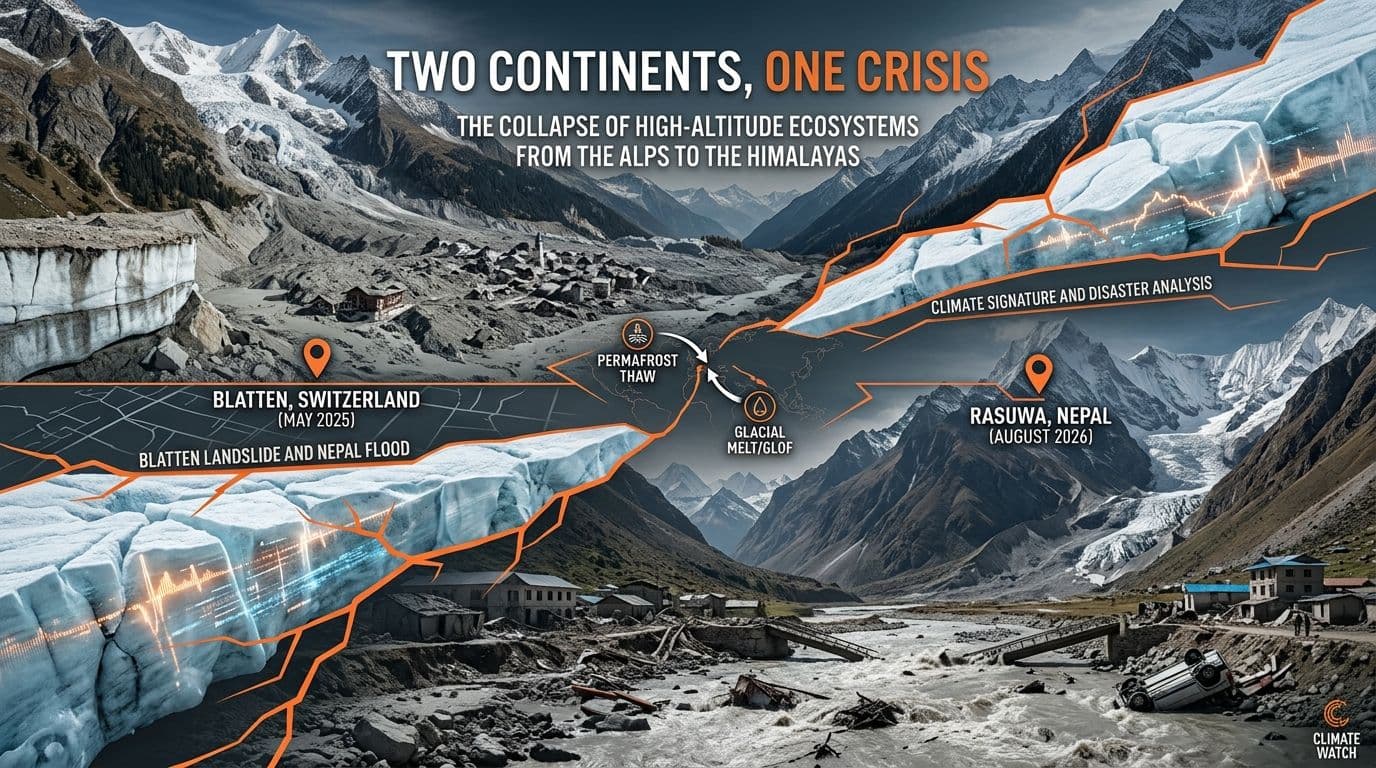
Global climate discourse predominantly centers on rising sea levels and agricultural drought scenarios. However, planet Earth's high-altitude ecosystems have become the primary epicenters where climate breakdown manifests with the greatest speed and severity. The Blatten disaster in the Swiss Alps and the recent destructive glacial flood event in Nepal—though occurring in distinct geographies—are direct outcomes of the same underlying climate mechanism.
Status Analysis: The Cases of Blatten and Rasuwa
In May 2025, the historic settlement of Blatten in the Valais canton of Switzerland was buried under millions of tons of debris and ice due to base-level sliding of the Birch Glacier accompanied by a simultaneous rockfall. Having lost the majority of its structural infrastructure, the settlement area was fully evacuated.
In a parallel trajectory, a glacial lake outburst flood (GLOF) and flash flood developed along the Bhote Koshi River basin in the Rasuwa region of the Nepalese Himalayas, inflicting severe damage on critical infrastructure, hydroelectric power plants, and residential areas downstream.
Common Climate Drivers and Dynamics
Far from being isolated natural disasters, these events represent the direct climate impacts of global warming on high-mountain ecosystems:
- Thermal Balance of Permafrost: The degradation of permanently frozen ground (permafrost) layers—which structurally anchor rock masses at high elevations—causes a loss of geotechnical stability on mountain slopes.
- Subglacial Subsurface Hydrodynamics: Rising surface temperatures allow meltwater to percolate to the bedrock beneath glaciers. This creates hydraulic pressure and reduces basal friction, triggering large-scale mass movements.
- Glacial Lake Outburst Floods (GLOF): Rapid glacial retreat accelerates the formation of fragile, moraine-dammed lakes. Exceeding their storage capacities, these structures trigger sudden water releases that generate devastating downstream flows across the river basin.
- Systemic Risk and Cascading Hazards: Both events carry the potential to trigger secondary disasters. Mass movements block river channels to form temporary natural dams, compounding the risk of catastrophic flooding in lower basins.
Socioeconomic Vulnerability and the Early Warning Divide
The fundamental divergence between the two regions stems from technical infrastructure and risk management capacity. While advanced monitoring and sensor networks in Switzerland can prevent potential mass casualties, limited climate monitoring infrastructure in Global South nations like Nepal leaves local communities exceptionally vulnerable to such sudden-onset disasters.
Conclusion and Policy Requirements
The processes observed in the Alps and the Himalayas demonstrate that mountain ecosystems have lost their historical structural stability. International climate adaptation strategies must be restructured to encompass high-altitude river basins alongside coastal zones. Without sustained global reductions in greenhouse gas emissions, mass destabilization in mountain ecosystems and the resulting basin-scale disasters will continue with increasing frequency.