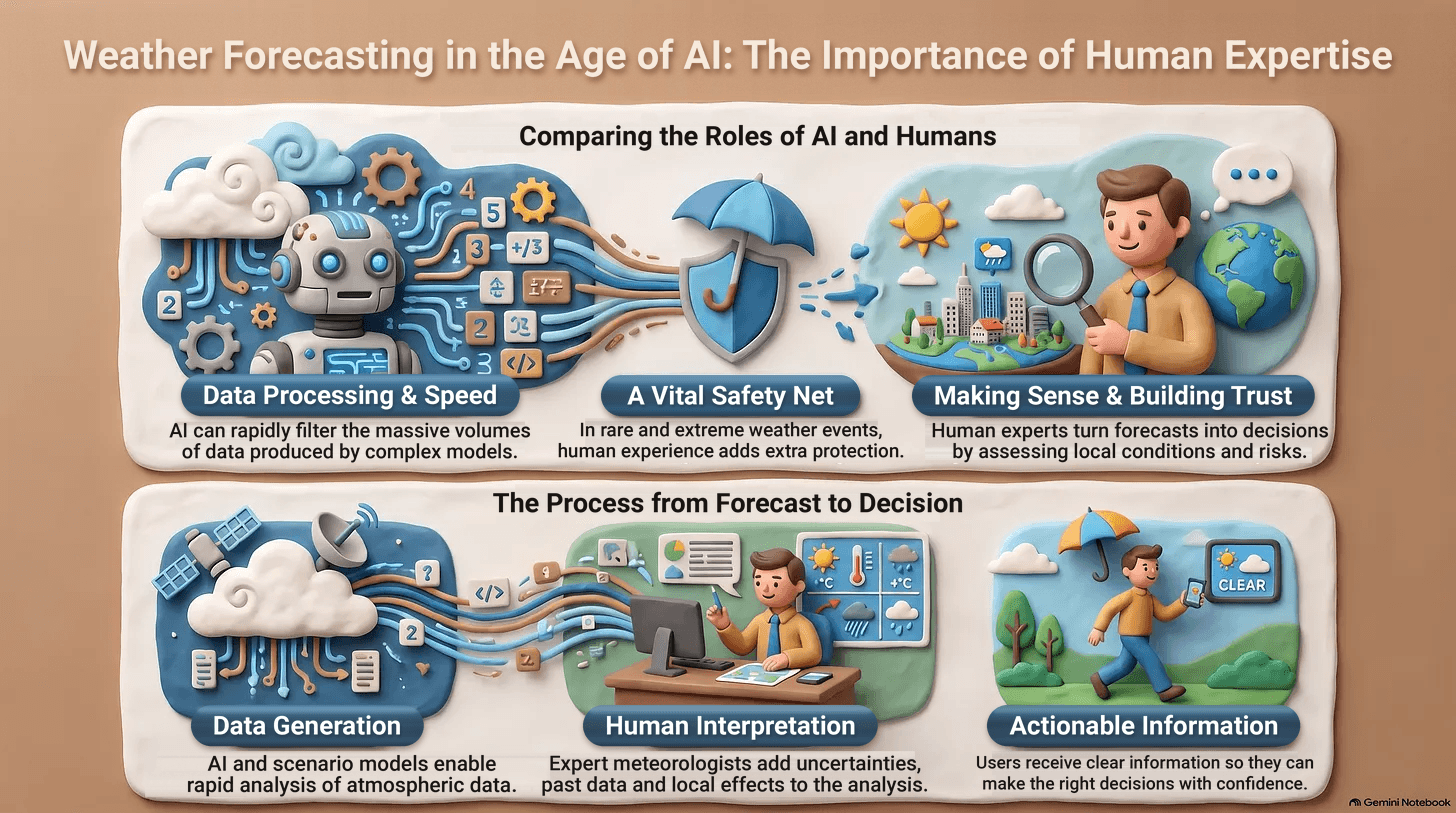
Artificial intelligence (AI) and machine learning technologies are emerging as an innovative, game-changing approach in meteorology and weather forecasting.
Challenging the traditional dominance of national meteorological services, these new technologies produce forecasts faster and demonstrate high forecast skill. However, an analysis presented by Steve Ramsdale, Operational Meteorologist at the UK Met Office, highlights a critical truth despite these technological advances: a forecast has no impact until it is used by a human.
The real value lies in how weather forecast data is interpreted, communicated and acted upon. While computers excel at processing vast volumes of data and recognizing patterns, humans remain indispensable in contextual reasoning, communication, managing uncertainty and decision support. Rather than replacing human expertise, the weather forecasting models of the future rest on building a strong partnership and collaboration between humans and AI.
From Data to Decision: Information Abundance and Human Judgment
Today’s modern forecasting systems generate enormous amounts of data, with hundreds of possible scenarios from the most advanced ensemble systems and new types of observations. At this point, the main challenge is not a lack of information but an abundance of it.
Machine learning methods are highly valuable for filtering useful information out of these vast and ever-growing data sources. However, decision-makers (meteorologists, emergency planners, transport operators) routinely face questions such as:
- How much should I trust this forecast?
- Which scenario is the most plausible?
- What are the consequences if the forecast turns out to be wrong?
These questions cannot be answered by scientific calculations alone; they require experience, context and human judgment. Weather models can calculate the multiple ways the atmosphere might evolve, but they cannot explain why these outcomes might occur. This ability to explain is a fundamental human competency for making decisions during severe weather events that can affect people’s lives.
Transforming Forecasts with a User-Centered Approach
Users rarely need raw forecast data. Human expertise plays a critical role in turning raw atmospheric information into information that can be turned into decisions.
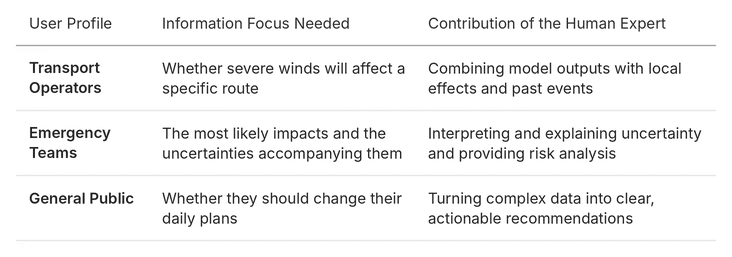
Experienced forecasters carry out their work by blending model outputs with local geographical effects, historical events, user requirements, and the known strengths and weaknesses of the models.
Trust, Explainability and the Changing Role of the Forecaster
One of the most important yet least discussed elements of the forecasting process is trust. Trust is built not only on forecast accuracy but also on transparency and consistency.
- Communicating Uncertainty: When an expert explains why confidence is low, users can factor that uncertainty into their own planning.
- Justifying Changes: When a forecast changes, users want to understand why.
- Explainability: Whether forecasts come from physics-based models or from machine learning, users need to be able to trust that the data is physically plausible and operationally meaningful.
Under these conditions, the role of experts is shifting from producing forecasts to questioning, challenging and explaining them.
Human Expertise as a Safety System and the Model for the Future
Operational forecasting processes have always relied on multiple layers of assurance. Human expertise acts as an additional safety system in situations where automated systems fall short: unusual atmospheric conditions, rare events, or local effects that are difficult to represent. The greatest opportunities of the future will come not from AI replacing humans, but from building better partnerships between humans and intelligent systems.
Gökhan Gürses